Sustainability is more than the environment
We look at sustainability in three connected layers: how the home affects the nature around it, how it affects the people who live in it, and how it lasts over time. A small, well-considered home can carry all three – and often it's the small home that does it best, because less floor area means less material to build, less energy to heat and less to maintain year after year.
The platform is built in aluminium – a material with a long service life and a high recyclability rate. The home floats, which keeps the impact on seabeds and ecosystems low. The compact footprint is energy-efficient, and with solar panels, a battery and off-grid systems you can draw less on shared infrastructure.
Having nature and the water right on your doorstep does something to everyday life. The light, the calm and the closeness to an open horizon are simple things that easily slip away on land but here sit just outside the window. Large glass surfaces let the daylight in, and the terrace takes you out into nature in a few steps. A home that makes you pause – and come close to what is good for us.
Low running costs and a long service life make ownership more predictable over time. Small but smart means fewer resources are used – both to build and to live. And because the home is movable, it retains a value that isn't locked to a single location.
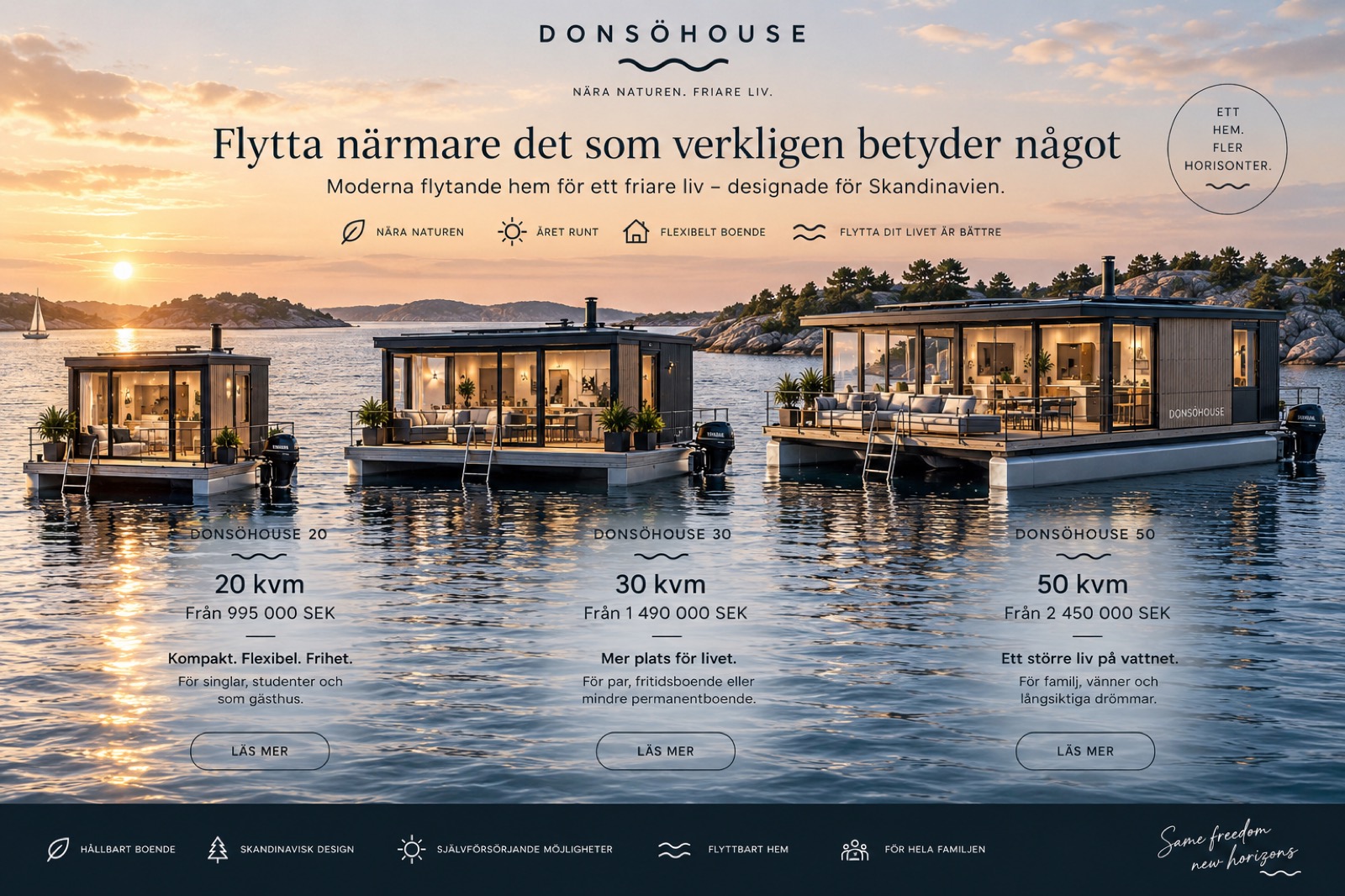
Water instead of concrete.
A house on land begins with an intervention: ground is prepared, foundations are cast, marks are left that remain long after the house is gone. A Donsöhouse begins the opposite way. It rests on the water and needs neither foundation, blasting nor dredging to stand firm.
When the home one day moves on, the site can in practice be restored. A floating home can be lifted or towed away – and the MOVE model can be driven away under its own power, because it is built as a vessel and classified as a boat. What remains is water, not a cast foundation.
We're not saying it's entirely without impact – all living leaves a mark, and what's possible always depends on location, mooring and local regulations. But compared with permanent building on land or in water, the starting point is different: as little that is lasting as possible, and as much as possible that can be undone.
It also means a placement can be reconsidered. If the location no longer suits you, or the conditions change, you don't need to demolish and start over – the home simply moves with you. A home that can leave a place untouched is a home that keeps its possibilities open, both for you and for the nature around it.
The most sustainable thing is what gets to live a long life.
A material that lasts, a floor area used wisely and a home that can follow you through life – that's sustainability you feel in everyday life, not just in a brochure. The aluminium platform is durable and ages well in saltwater, and the compact dimensions mean every square metre actually gets used.
A robust aluminium platform built for Nordic conditions – and to age beautifully.
Fewer square metres to heat, maintain and furnish. Fewer resources, more life.
Insulated for year-round living, with the option of solar, battery and off-grid.
Can be lifted, towed or driven away. The water can in practice be restored.
Sustainability – the things you tend to wonder about
The most common questions about footprint, seabeds and energy. Conditions vary with location and regulations – always check what applies locally.
Is a floating home really more sustainable than building on land?
A Donsöhouse is built on a floating platform and needs no foundation, no blasting and no ground preparation. That means the land and the shoreline can be left untouched. The total environmental impact naturally depends on how you live, of course, but the placement itself leaves a small and fundamentally reversible footprint.
What happens to the seabed and the water beneath a Donsöhouse?
Because the home floats, neither dredging nor fixed interventions in the seabed are normally required. The aim is to affect light, water flow and life on the bottom as little as possible. The exact mooring solution depends on the location and local conditions, and we always choose the gentlest solution that works where you are moored.
Can a Donsöhouse be removed again?
Yes. A floating home can be lifted or towed away, and the MOVE model can even be driven away under its own power. When the home leaves the site, the water can in practice be restored – unlike a building with a cast foundation. That makes the home highly reversible.
How energy-efficient is a Donsöhouse?
Every model is insulated for the Nordic year-round climate, and the compact footprint means less energy is needed to heat the home. With solar panels, a battery bank and expanded systems you can also move towards an off-grid life and reduce your dependence on external infrastructure.
Live closer to nature – and leave it almost untouched
A brochure with models, floor plans and prices – plus answers to your questions about sustainability and placement. No obligation.